वे
Ведамрита
question page
To skills
karma and spirituality · personal 30-day plan

Can you be a believer and see a psychologist at the same timewith clarity and dignity

A calm look at the question: what hurts, where facts and fears are mixed, what can be done today, and how to preserve dignity in the process.

Can you be a believer and see a psychologist at the same timekarma and spiritualitypersonal planbirth chart30-day practice

A few questions, birth data, and 30 days of practice in your rhythm.

then
past
messages, hope, replaying
now
support
boundaries, breath, one step a day
Can you be a believer and see a psychologist at the same time? — Vedic visual code
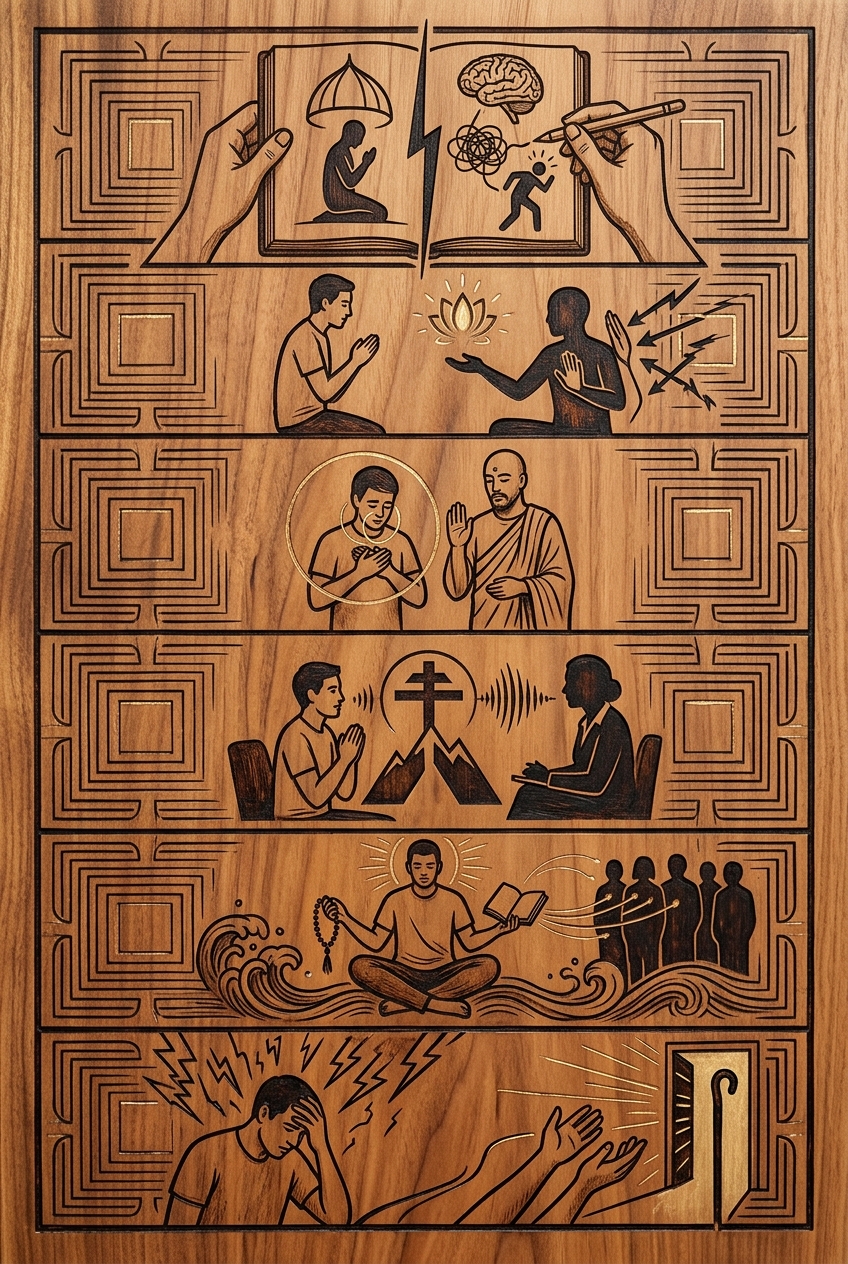
visual code of the question

An image to contemplate

The image gathers the meaning of the page into symbols: path, choice, light, inner support, and the link between ancient knowledge and present life.

Click the image to open the full version.
What may stand behind the question
There is an outer event and an inner knot
The question “Can you be a believer and see a psychologist at the same time?” is usually not only about an event, but also about how the mind, memory, and expectations gather tension around it.
Clarity comes first
It helps to separate facts from guesses, feeling from action, and your responsibility from what is outside your control.
A small step is better than a perfect answer
In the area of karma and spirituality, one truthful action often helps more than another round of thinking.

Can you be a believer and see a psychologist at the same time?

The question “Can you be a believer and see a psychologist at the same time?” usually appears when a person is already tired of going in circles. Here it is important to calmly separate facts from feelings and see the first honest step.

30
days of gentle practice
1x
birth chart profile
AI
Amrita support
reflection and first steps

Where to begin

The question “Can you be a believer and see a psychologist at the same time?” does not need a rushed answer. Often behind it are fatigue, anxiety, hurt, hope, or a sense that the situation keeps repeating. If you immediately look for a final solution, you may miss the most important thing: what is actually happening now, and what small step is truly within your power.

In the spirit of the shastras, it is helpful to begin with sobriety. Not to suppress feelings, but also not to give them the right to govern every action. Feelings show where it hurts. Reason helps you see what to do. The soul reminds you that a person’s dignity is deeper than any single situation.

What may be inside this situation

Sometimes the intensity is connected with a specific event: religious doubts. Sometimes it is connected with a recurring pattern: faith and psychotherapy. Sometimes a person does not understand how to act because everything has become mixed together: is it a sin to turn to a psychologist?

Try, for a minute, not to solve the problem, but to look at it. What is a fact? What is your assumption? Where are you afraid of losing love, respect, safety, or control? Where has there long been a need not for a new analysis, but for a boundary or an action?

Three simple observations

  • If a thought repeats many times, it does not always become wiser. Sometimes it needs to be written down on paper, followed by a pause.
  • If an action leaves shame or emptiness afterward, perhaps it is not a solution, but a way to quickly reduce anxiety.
  • If you call patience spirituality, but resentment and weakness are growing inside, it is worth honestly looking at whether fear is hiding there.

What to do today

1. Write the situation in three lines: what happened, what I feel, what I am afraid of. 2. Separate fact from interpretation. A fact can be checked; an interpretation is often born from pain. 3. Choose one action that does not destroy either you or another person: a conversation, a pause, a request, a boundary, a refusal to follow an impulse. 4. For one day, stop the habit that strengthens the cycle: arguing, checking, replaying, blaming, or silently enduring. 5. Ask yourself: “How can I act here with dignity and truth?”

What is better to avoid

Do not make important decisions at the peak of emotion. Do not use spiritual ideas to justify inaction or to endure what is destructive. Do not demand perfect clarity from yourself right away. Sometimes the first step is not a final answer, but an honest pause, prayer, a conversation with a reasonable person, and one small action.

In the spirit of the shastras

The shastras do not call us to weakness. They teach us to see more deeply: behind the outer situation there is the mind, desires, attachments, duty, freedom of choice, and the soul. Practical reason is as important as gentleness. A pure heart does not mean naivety. Mercy does not cancel boundaries. Humility is not the same as refusing the truth.

If you need a personal path

This reflection offers general support. A personal 30-day plan is needed when you want to apply it to your own life: to your character, circumstances, birth chart, and specific pattern. Then each day becomes not a general phrase, but a small step you can actually live.

How the personal plan deepens this guide

Get a personal plan for faith and therapy

This page gives the general map. The personal 30-day plan turns it into daily practice around your birth chart, answers, and current situation.

Day 1-3

See the real situation

We start not with an abstract topic, but with your context: can you be a believer and see a psychologist at the same time. We notice where the question becomes sharp.

Day 4-10

Understand the inner knot

We look at the need behind “Can you be a believer and see a psychologist at the same time?” and the reactions that repeat automatically.

Day 11-20

Set boundaries and supports

We add practical intelligence: what to stop, what to protect, where gentleness is needed, and where clear action is needed.

Day 21-30

Anchor the new skill

Understanding becomes rhythm: can you be a believer and see a psychologist at the same time turns from anxiety into daily practice.

01

Personal chart

Birth date, time, and place tune the tone and rhythm to a person, not to an average audience.

02

Skill scenario

The skill “Can you be a believer and see a psychologist at the same time?” unfolds through a human situation, signs, mistakes, and first actions.

03

Knowledge and sobriety

The Vedic view meets practical intelligence: karma and spirituality is approached without naivety and without pressure.

04

30 days of anchoring

Each day opens a small practice, a heart question, and an action that can be done today.

What stops feeding the problem
Making a decision at the peak of emotion.
Confusing facts with assumptions born from pain.
Calling fear humility or spiritual acceptance.
Replaying the same thought again and again without taking a single honest step.
Ignoring the need for boundaries where they are already necessary.
Where the path begins
Write down: what happened, what I feel, what I am afraid of.
Separate verifiable facts from interpretations.
For one day, stop the habit that strengthens the cycle.
Choose one action that preserves dignity.
Ask a calm, reasonable person for advice if it is difficult to see clearly on your own.
Shastric lens

In the spirit of the shastras, the question “Can you be a believer and see a psychologist at the same time?” should be considered without panic and without self-deception: see the facts, acknowledge the feelings, preserve the dignity of the soul, and choose an action that does not destroy either you or others.

Turn this question into practice, not endless thought

Vedamrita builds the path so you do not only understand the answer, but live it in small steps.